

Please Leave Us A Message
Privacy statement: Your privacy is very important to Us. Our company promises not to disclose your personal information to any external company with out your explicit permission.
Corrugated stainless steel tubing DN10 DN15 DN20 DN25 DN32 dimensions are defined by three numbers buyers routinely confuse: nominal size, actual outside diameter, and wall thickness. A DN20 gas tube is not a 20 mm pipe. Across the international standards governing this product, the DN20 tube carries an outside diameter between 21.7 mm and 25.0 mm depending on which standard the mill built to, with a 0.25 mm wall and a bore not below 19.6 mm. Get it wrong and the fittings will not mate.
Getting this right at the specification stage is the difference between a landed container that sells and one that sits in your warehouse. This article covers what the dimensional requirements are, how they map across ISO 10380, EN 15266 and ANSI LC-1 / CSA 6.26, and where they diverge.
Hangzhou Hengtong Metal Hose Co., Ltd. has produced small-diameter mechanically formed stainless corrugated pipe since 1990 and supplies both CSST tubing and flexible connectors to North American, European and Asian markets under CSA, IAPMOF and ISO certification. Our data sheets give nominal size, bore, outside diameter, pitch and bend radius for every size we make.
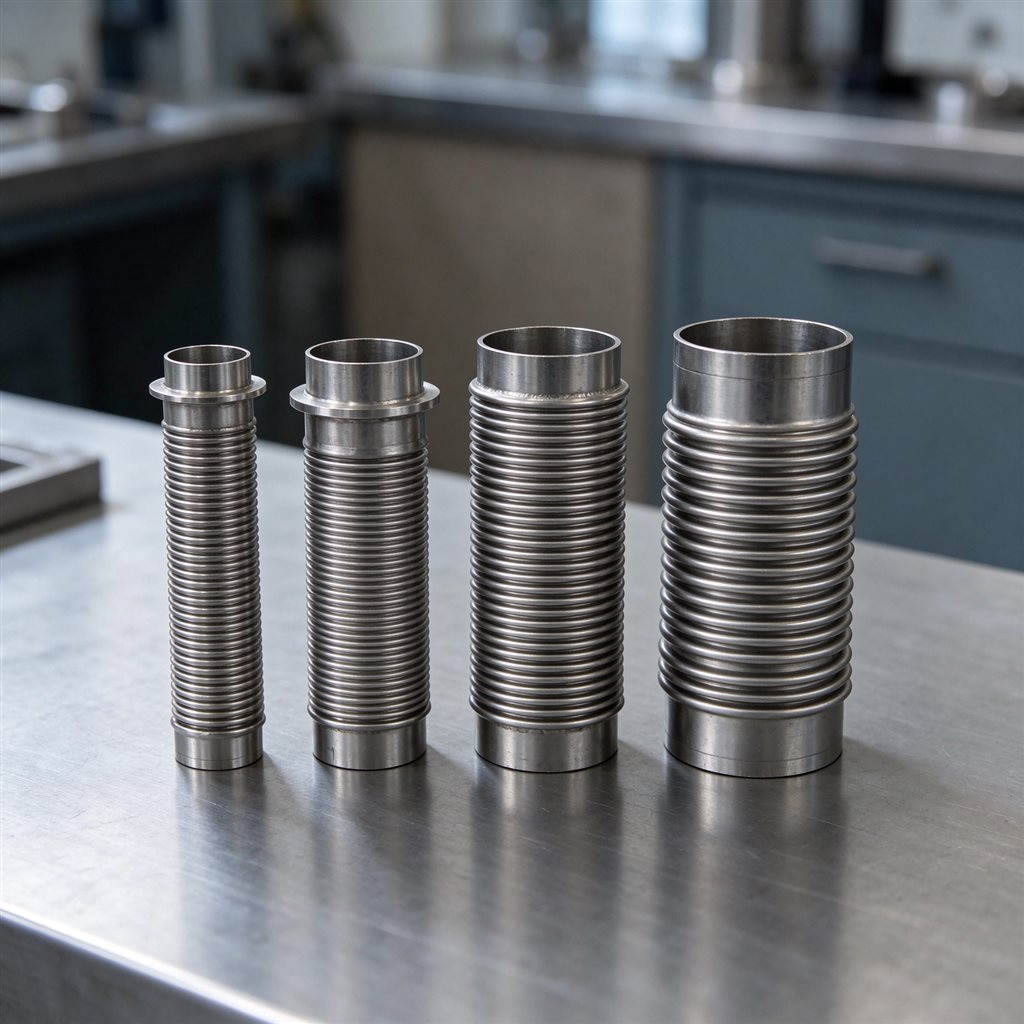
Six dimensions govern every corrugated gas tube: nominal size, wall thickness, bare-tube bore, bare-tube outside diameter, coating thickness and corrugation pitch — plus the thread standard.
The trap is that the bare tube — the mechanically formed corrugation before any coating — carries a smaller outside diameter than the finished hose, because the jacket adds thickness on top. And nominal size is a bore designation, not a diameter.
| DN | Wall thickness (mm) | Bare tube bore (mm) | Bare tube OD (mm) | Pitch (mm) | Minimum bend radius (mm) | Thread family |
| 10 | 0.25 ± 0.02 | 9.8 ± 0.3 | 13.7 ± 0.2 | 3.0 ± 0.20 | 20 | R (Rp, Rc) |
| 13 | 0.25 ± 0.02 | 12.8 ± 0.30 | 16.0 ± 0.2 | 4.0 ± 0.20 | 25 | R (Rp, Rc) |
| 15 | 0.25 ± 0.02 | 14.8 ± 0.3 | 18.7 ± 0.2 | 4.0 ± 0.20 | 25 | R (Rp, Rc) |
| 20 | 0.25 ± 0.02 | 19.8 ± 0.30 | 25.0 ± 0.3 | 4.5 ± 0.20 | 30 | R (Rp, Rc) |
| 25 | 0.30 ± 0.025 | 24.8 ± 0.40 | 32.0 ± 0.3 | 5.0 ± 0.3 | 40 | R (Rp, Rc) |
| 32 | 0.30 ± 0.025 | 31.8 ± 0.40 | 40.0 ± 0.4 | 6.0 ± 0.3 | 50 | R (Rp, Rc) |
These values sit inside the envelope the international standards allow. The corrugated stainless steel tubing DN10 DN15 DN20 DN25 DN32 dimensions a European mill quotes from ISO 10380 differ slightly: ISO 10380:2012 gives DN10 an OD of 13.5 mm, DN15 of 17.2 mm, DN20 of 21.7 mm, DN25 of 27.5 mm and DN32 of 35.0 mm. EN 15266 sits between, at DN12 with a 15.8 mm OD and 5.0 mm pitch, rising to DN50 with a 61.0 mm OD.
Four practical points follow — and the minimum bore 98 percent DN ISO 10380 gas tubing requirement applies to every line of them. The gas tubing nominal diameter vs outside diameter difference is the one to settle first:
The minimum bore 98 percent DN ISO 10380 gas tubing requirement is where the standards converge. ISO 10380:2012 sets the flow-critical rule: internal diameter shall not be less than 98% of the nominal size designation. Check DN25 and it passes with margin — 24.8 mm against a 24.5 mm floor. This check separates a genuine mechanically formed tube from a welded substitute with a smaller bore at the same DN label.
The standards agree on the minimum bore rule and the wall progression, and diverge on outside diameter, bend radius and thread — which is why the mill's data sheet, not the standard number, is what must appear on your order. The gas tubing nominal diameter vs outside diameter difference is the one buyers most often leave undefined in a purchase order, and it is the one that stops a container from matching its fittings. The minimum bore 98 percent DN ISO 10380 gas tubing requirement is the rule they most often assume rather than verify.
ISO 10380:2012 covers corrugated metal hoses and assemblies as a general international standard, and its dimensional requirement is a single hard rule — it fixes neither coating thickness nor corrugation pitch. ANSI LC-1 / CSA 6.26 adds the system requirements: fittings, striker plates, bonding, pressure ratings. EN 15266 adds the material grade (EN 1.4404 / 316L), the EN 13501 flame and smoke criteria for the jacket, and marking.
Bend radius is where the manufacturer has most say and the buyer least warning. International practice publishes two values per size — an absolute minimum and a suggested working radius. Common EN 15266 / ISO 10380 reference figures: 19 mm absolute / 75 mm suggested at DN15, 25 mm / 75 mm at DN20, 76 mm / 125 mm at DN25 and DN32, 102 mm / 150 mm at DN50. North American guidance says the same in inches — roughly 3 in radius up to 1-1/4 in, 5 in for larger. The minimum is a hard limit; the suggested radius protects the corrugation.
Two questions come up in every export enquiry:
Which thread do I actually need? Name the standard, not the size: "DN20, R3/4 female, ISO 7-1, to EN 15266" for European work, or the equivalent NPT designation for a North American CSST system. Mating a metric thread to a North American fitting set produces a joint that looks assembled and leaks.
What is the coil length and what does it weigh? Standard supply is 30 m and 50 m rolls, with DN10 to 100 m. Coil weight scales with diameter: a DN10 50 m roll runs about 3–4 kg, DN15 50 m about 5–6 kg, DN20 50 m about 7–8 kg, DN25 50 m about 9–11 kg, and DN32 30 m about 10–12 kg. That figure drives the freight maths: a 40 ft container of DN20 50 m coils carries roughly 500 rolls.
Hangzhou Hengtong Metal Hose Co., Ltd. supplies the RSB series from DN10 to DN32 in 304 and 316L, with yellow or transparent-yellow polyethylene coating, in 30 m and 50 m coils, plus matched fittings in metric, NPT and G thread families. Above DN32 we manufacture to the equivalent dimensional envelope under your drawing and ISO 10380 bore rules. For most export enquiries the corrugated stainless steel tubing DN10 DN15 DN20 DN25 DN32 dimensions on our data sheet are the working reference you can specify directly.
✅ Bottom line: Quote DN, bare-tube bore, outside diameter, thread family and bend radius together. Size alone will not match your fittings, and the 98% bore rule proves the tube is genuine.
✅ Bottom line: Get the mill's data sheet, not the standard number, onto the purchase order before the container is booked.
Q: Why does the same DN20 come with a different outside diameter from different suppliers? A: Because several standards cover this product, and their dimensional envelopes are not identical — ISO 10380 gives 21.7 mm, EN 15266 and the Chinese GB standard for gas transmission tubing give 25.0 mm. The bore requirement is common to all of them at 98% of DN; the outside diameter is not. Always state the outside diameter you need for fitting compatibility rather than assuming one value.
Q: Is a 0.2 mm wall acceptable for DN20 if the supplier quotes it? A: It depends on the standard and the listing. The 0.25 mm figure is the common production wall for DN10–DN20 across the international norms, and it is what carries pressure and resists handling damage. Ask for the mill certificate and the batch test report — the wall thickness on the certificate is the number that counts.
Q: Can I source DN40 or DN50 to the same specification? A: Yes, but EN 15266 covers DN10 to DN50 while ANSI LC-1 / CSA 6.26 stops at 2 in. nominal bore, so the markets diverge above DN32. HENGTONG manufactures above the DN32 ceiling to drawing, with the envelope, bend radius and certification position agreed before production.
Send us your DN size, thread family, length, pressure class and coating colour, and we will return the dimensional data sheet, weight-per-roll figures, MOQ, lead time and a factory-direct price. HENGTONG supplies OEM and ODM corrugated stainless steel gas tubing and connectors to importers, distributors and appliance manufacturers — custom diameters, wall thicknesses, pitch, coating colours and private-label printing, with full test documentation. Hangzhou Hengtong Metal Hose Co., Ltd. runs 6,000 m² with 10+ automated lines and 1,000+ tonnes of annual capacity. Ask for the free data sheet and we will confirm the dimensions.


Let's get in touch.
Privacy statement: Your privacy is very important to Us. Our company promises not to disclose your personal information to any external company with out your explicit permission.
Fill in more information so that we can get in touch with you faster
Privacy statement: Your privacy is very important to Us. Our company promises not to disclose your personal information to any external company with out your explicit permission.