

Please Leave Us A Message
Privacy statement: Your privacy is very important to Us. Our company promises not to disclose your personal information to any external company with out your explicit permission.
Hangzhou Hengtong Metal Hose Co., Ltd. has manufactured mechanically formed stainless steel corrugated gas hose since 1990 and pioneered the tapered rigid-seal connection structure defining how our tube is terminated. The bend radius rule follows from how the corrugation is formed — which is why our data sheets state a minimum radius per size.
Corrugated gas hose installation bend radius minimum avoid fatigue crack is not a guideline — it is the most common cause of premature failure, and the failure looks nothing like the mistake that caused it. Bend a corrugated stainless steel gas tube tighter than its minimum radius and the corrugation peaks collapse. The hose still passes a visual check, still holds gas, and looks fine at installation. It then works the collapsed section into a slow, nearly invisible fatigue crack that can take two or three years to become a leak.
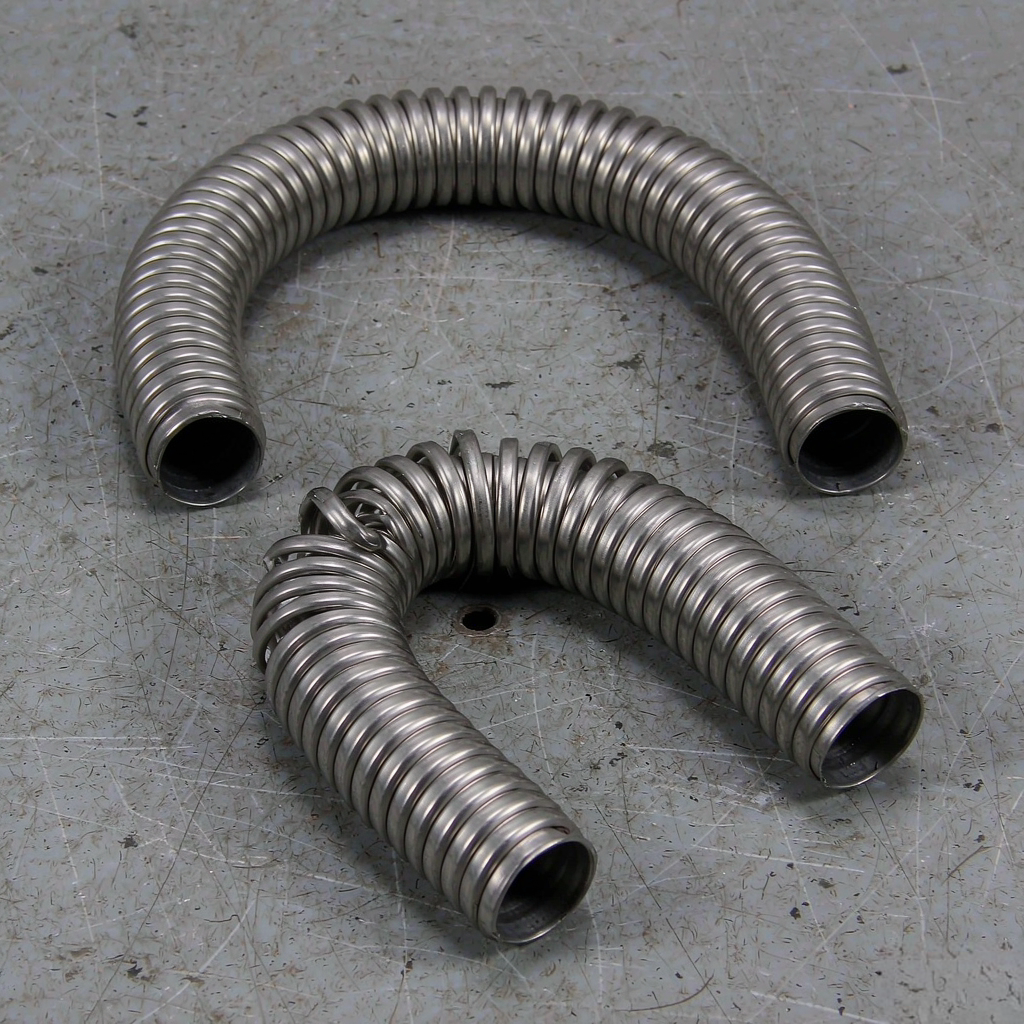
The minimum bend radius is the tightest curve the corrugation can take before its peaks collapse.
Corrugated stainless steel tubing works because the convolutions absorb strain. When the tube is bent, the pipe wall does not stretch — corrugations open outside the bend and close inside. Within the rated radius the metal stays elastic and returns to shape. Past it, the outside peaks flatten, the section loses its annular modulus, and load transfers into the pipe wall as bending stress. This is why corrugated gas hose installation bend radius minimum avoid fatigue crack belongs in the purchase order rather than in the installer's judgement.
Corrugated gas tubing support spacing hanger interval requirement matters for a non-obvious reason. A correctly bent hose still needs support, because the bending moment at a bend is carried along the unsupported length, and every hanger too far apart adds to the moment the bend must absorb. North American practice defers to the manufacturer's instructions — CSST is typically supported every 4 to 6 ft on horizontal runs, with vertical runs supported at every floor level — and European practice follows the same shape under BS 6891 and EN 1775:
Those rules exist for one reason: to keep the corrugation in its designed geometry for the life of the system.
The failure mode deserves emphasis because it does not look like a bending failure. An over-bent hose does not necessarily leak at the bend. It develops stress concentration at the collapsed peaks, and over time — accelerated by pressure cycling, thermal movement and settlement — a hairline fatigue crack initiates outside the bend and propagates through the wall. The symptom is often weeping at the fitting, which gets blamed on the fitting. The fitting is re-torqued; the crack remains.
Corrugated gas hose stress corrosion cracking chloride cause prevention interacts directly with bend radius, and this second-order effect makes the rule non-negotiable. Chloride stress corrosion cracking needs three conditions at once: chloride ions, a tensile stress, and temperature above roughly 50°C — the mechanism behind the recalls of uncoated stainless connectors in the 1980s and 1990s. A collapsed corrugation is permanent tensile stress built into the metal. Coastal atmospheres and pool chemicals supply the chlorides; a hot appliance area supplies the temperature. Bent within its rated radius the hose has no residual stress; bent past it, two of three conditions are already met.
This is also why the polyethylene jacket on a listed CSST system is not cosmetic. It provides a chloride barrier over the corrugated body, and on systems with a leak-detection function the jacket must be permeable enough that a pressure drop registers through it — how a buried leak gets located rather than found.
✅ Bottom line: Use the manufacturer's published minimum bend radius for each size, keep the straight run their instructions specify, and never re-bend at the same point. Violating it does not fail today; it fails in year three.
Specify the radius on the purchase order as a number, not as "flexible" — the data sheet is where the number lives, and the installer will never look it up.
The RSB series dimension data gives the minimum bend radius per nominal size — this is the specification to write into your order:
| DN | Bare tube OD (mm) | Absolute minimum bend radius (mm) | Suggested working radius (mm) | Approx. inch equivalent |
| 10 | 13.7 | 20 | 75 | 3 in radius |
| 15 | 18.7 | 19–25 | 75 | 3 in radius |
| 20 | 25.0 | 25 | 75 | 3 in radius |
| 25 | 32.0 | 30–76 | 125 | 5 in radius |
| 32 | 40.0 | 50–76 | 125 | 5 in radius |
Note the two-tier structure, the convention in the ISO 10380 / EN 15266 reference data and in every leading manufacturer's manual: an absolute minimum the tube must not be bent tighter than, and a suggested working radius that preserves flow and margin. North American practice says the same in inches — roughly 3 in radius for tubing up to 1-1/4 in, 5 in for larger. Where a drawing conflicts with the radius, the answer is not a tighter bend but an elbow fitting.
For buyers auditing an installed system, the failure indicators are specific — and a corrugated gas hose stress corrosion cracking chloride cause prevention review starts with the bends:
HENGTONG states the minimum bend radius on every data sheet and supplies the corrugated gas tubing support spacing hanger interval requirement alongside it, in the format your installer and inspector will both use. As a factory supplier we build to your customer's listing requirements, and our tapered rigid-seal termination removes the gasket and circumferential weld — the two traditional weak points in a corrugated gas line. Ask for the bending data sheet and we will confirm the figures.
Hangzhou Hengtong Metal Hose Co., Ltd. runs 6,000 m² with 10+ automated lines and 1,000+ tonnes of annual capacity. We supply OEM and ODM corrugated stainless steel gas hose to importers and distributors — matched fittings, custom lengths and private-label packing. Ask for the bending data sheet and we will confirm the figures.
✅ Bottom line: Use the manufacturer's published minimum bend radius for each size, keep the straight run their manual specifies, and never re-bend at the same point. Write all three on the purchase order — the installer will not look them up.
Q: What happens if the hose is bent tighter than the minimum radius — will it fail immediately? A: Usually not. Corrugated gas hose installation bend radius minimum avoid fatigue crack is a compounding, not immediate, failure. The corrugation peaks flatten and the section loses capacity, but the hose generally holds pressure and passes a visual check. The crack then propagates through cyclic loading, so the leak typically appears two to three years later and is often misdiagnosed as a fitting problem. The radius is therefore a specification item, not an installation preference.
Q: Can I bend the hose again later to reposition an appliance? A: No. Installation instructions prohibit repeated bending at the same point because each bend works the metal. If the appliance must move, replace the hose. This is also the structural difference between fixed piping and an appliance connector — the latter is designed for movement, the former is not.
Q: What support spacing do you recommend? A: Follow the code minimum and the manufacturer's data sheet together, and never let hanger spacing relax the bend radius. HENGTONG supplies the corrugated gas tubing support spacing hanger interval requirement per DN size. Where vibration matters, specify double-braid construction or isolating clamps.
Send us your DN size, run length and installation detail, and we will return the minimum bend radius, the straight-run requirement, the hanger interval and a factory-direct price. For a corrugated gas hose stress corrosion cracking chloride cause prevention review, we will flag which install details put the coating at risk. HENGTONG supplies OEM and ODM corrugated stainless steel gas hose to importers and distributors — matched fittings, custom lengths, assemblies to length and private-label packing. Hangzhou Hengtong Metal Hose Co., Ltd. has produced corrugated gas hose since 1990. Request the bending data sheet and we will confirm the figures.


Let's get in touch.
Privacy statement: Your privacy is very important to Us. Our company promises not to disclose your personal information to any external company with out your explicit permission.
Fill in more information so that we can get in touch with you faster
Privacy statement: Your privacy is very important to Us. Our company promises not to disclose your personal information to any external company with out your explicit permission.