

Please Leave Us A Message
Privacy statement: Your privacy is very important to Us. Our company promises not to disclose your personal information to any external company with out your explicit permission.
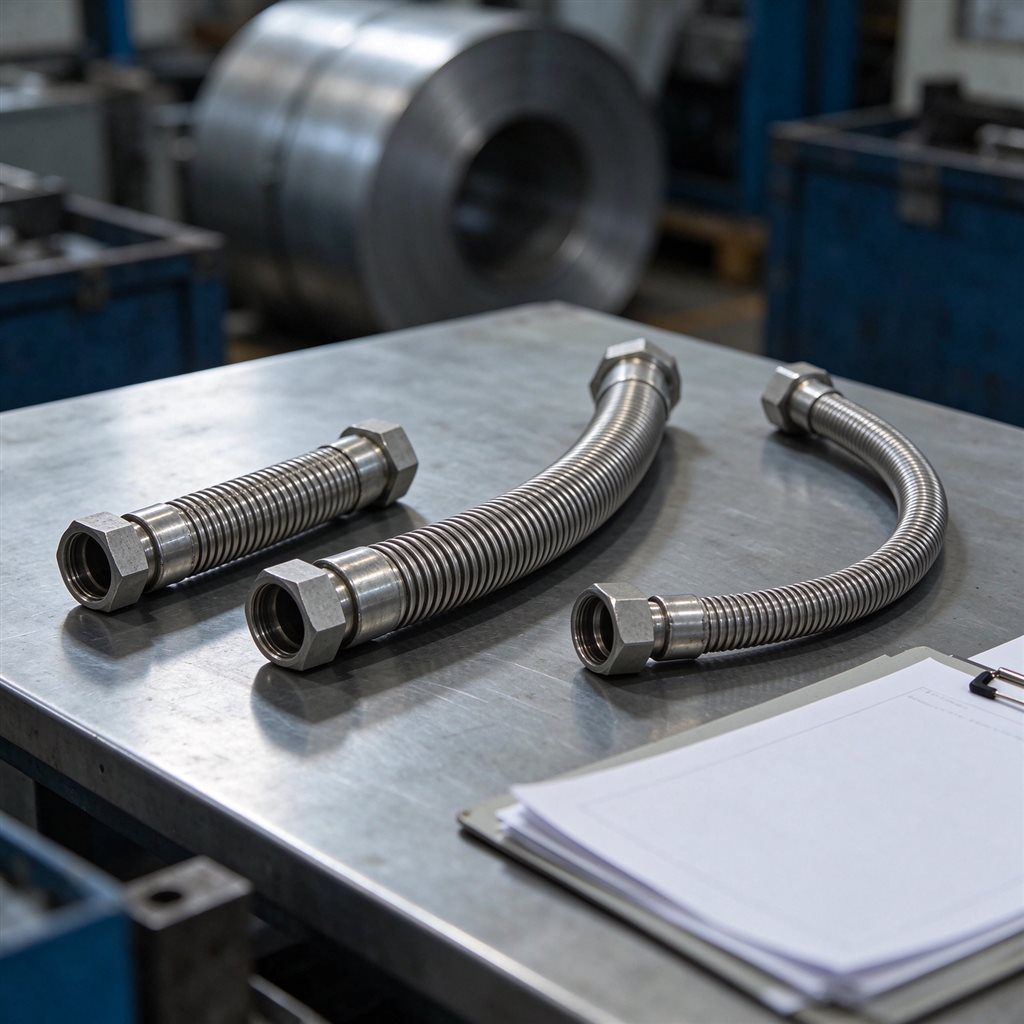
The practical question is never "is this a good hose." It is "which market is this going into, and what does that market's listing regime require."
Hangzhou Hengtong Metal Hose Co., Ltd. has manufactured stainless steel corrugated gas hose since 1990, was the first Chinese producer to export this product type to the United States (IAPMOF approval, 1994), and has held CSA certification for decades. Our enterprise standard Q/HHT-2000, developed in 1999, integrated American ANSI/AGA gas metal hose manufacturing standards — we build to a North American-derived specification as well as the listings below.
The frameworks differ genuinely in scope, and the distinction that trips up most buyers is which product each one covers and whether the tube may go underground. The EN 15266 vs ANSI LC-1 CSST standard comparison for export is therefore not about which is stricter — it is about whether you are selling a system or a connector.
The most consequential line in ANSI LC-1 is clause 1.3: "This Standard does not apply to CSST, whether coated or uncoated, intended for direct burial underground." Buried tubing must be encased in an approved conduit or part of an approved engineered system. Meanwhile clause 1.8 excludes gas appliance connectors entirely — those live under ANSI Z21.24 / CSA 6.10, Z21.69 / CSA 6.16 and Z21.75 / CSA 6.27.
EN 14800 vs EN 15266 gas hose which to use is decided by the same product-role test: EN 15266 handles stainless steel pliable corrugated tubing kits for buildings with MOP up to 0.5 bar, DN10 to DN50, for 1st, 2nd and 3rd family gases, while EN 14800 covers corrugated safety metal hose assemblies for connecting domestic appliances, also below 0.5 bar. Italian buyers add UNI 11353:2010, a stricter supplement covering corrosion resistance, flame retardancy and vibration resistance.
| Framework | Covers | Size limit | Pressure | Burial | Key exclusion |
| ANSI LC-1 / CSA 6.26 | CSST piping system incl. fittings and striker plates | ≤ 2 in. (nominal ID) | 5 psi or 25 psi listed ratings | Direct burial not covered — conduit or engineered system required | Appliance connectors |
| ANSI Z21.24 / CSA 6.10 | Flexible appliance connectors | Typical 3/8–3/4 in ID | Up to 1/2 psi | Not applicable | Not a piping system |
| EN 15266 | Stainless pliable corrugated tubing kits | DN10–DN50 | MOP ≤ 0.5 bar | Allowed with protective sleeve and leak-check provision | DME media |
| EN 14800 | Domestic appliance connector assemblies | Fixed lengths | Below 0.5 bar | Not applicable | Not a piping system |
| DVGW G 5616 / EN ISO 10380 | German DVGW approval and general hose standard | DN10–DN50 | Per EN 15266 | Per local rules | — |
| UNI 11353:2010 | Italian domestic appliance connectors | Fixed lengths | Below 0.5 bar | Not applicable | — |
| AS/NZS + Watermark | Australian / New Zealand plumbing and gas products | Per listing | Per listing | Per listing | — |
Three cross-market gaps catch buyers out:
The EN 14800 vs EN 15266 gas hose which to use question follows that same logic: a fixed-length appliance connector and a pliable piping kit are different products with different files, even when both are formed from the same corrugated strip.
The EN 15266 vs ANSI LC-1 CSST standard comparison for export therefore reduces to three questions every supplier should answer: which listing covers the product role, what the material grade is, and who may install it.
✅ Bottom line: Each standard excludes what it does not cover — ANSI LC-1 excludes direct burial and appliance connectors, EN 15266 and the Chinese national standard both exclude dimethyl ether media. Read the scope clause, not the product name.
The package is assembled in a fixed order: manufacturing conformity first, then the destination-market listing, then the shipment documents — and skipping the first step invalidates the second.
For a North American destination, the sequence importers should require from a factory is:
For Europe, substitute EN 15266 with DVGW G 5616 certification and EN 14800 for the appliance-connector category. Where the project requires PED 2014/68/EU pressure-equipment compliance or EN 14585 assembly qualification for PS above 0.5 bar, request the Declaration of Conformity and any notified-body opinion with the quote. For Australia, request the AS/NZS listing and Watermark certification; for South America, the ENARGAS and IRAM approvals that Argentine and Brazilian code requires.
This is where most RFQs fail. A supplier quoting a price against a DN size and nothing else is quoting a product with no defined market approval. The GB/T 26002 equivalent ANSI LC-1 CSA 6.26 certification question has a document-set answer: the national standard governs how the tube is built, the ANSI/CSA listing governs where it may be installed, and the market-specific certification — CSA, UL, IAPMO, DVGW, Watermark — governs whether it may be sold there at all. A factory that holds only its domestic standard cannot answer it.
One more point for the RFQ. The ANSI LC-1 CSA 6.26 vs ANSI Z21.24 CSA 6.10 difference determines not just the listing but the cost and lead time: new gas product certification cycles in North America run 12–18 months, including factory inspection and follow-up audits. A supplier with a live listing has absorbed that cost; one without will quote a timeline that puts your project season at risk.
✅ Bottom line: Chinese standards govern how the tube is made; ANSI/CSA, EN/DVGW, AS-NZS and Watermark govern where it may be installed and sold. Approval is additive, never automatic, and each must be specified separately.
Q: Does holding CSA certification cover European requirements as well?
A: No — the two are independent files with separate test programmes and factory audits. A CSA listing to ANSI Z21.24 / CSA 6.10 or ANSI LC-1 / CSA 6.26 certifies the product against the North American standard; it says nothing about EN 15266, DVGW G 5616 or PED compliance. HENGTONG maintains the North American track and can supply EN-performant product on request, but the two certificate sets are separate documents. When you need the Canadian listing, ask for it and the rest of the package as separate lines.
Q: Our project is in Germany. Which approval do we specify?
A: On the EN 14800 vs EN 15266 gas hose which to use choice: EN 15266 for the pliable tubing kit with DVGW G 5616 certification, and EN 14800 for the appliance connector. Confirm the grade — EN 15266 specifies 316L (EN 1.4404), where many Chinese mills supply 304 (S30408). Where assembly certification is required above 0.5 bar, request EN 14585 evidence.
Q: Can one factory supply product compliant for China, Europe and North America from the same line?
A: In principle yes, but the grade, coating, fittings and documentation differ by market, so the products are not interchangeable and should be separate SKUs. We build to each market's requirement separately. Ask any factory for the certificate set per destination — specifically what the Canadian listing covers for direct burial — and you will see who has prepared it and who has not.
Tell us the destination market, the product role and the size, and we will return the model, the full certificate set covering it, the MOQ and a factory-direct price. HENGTONG provides OEM and ODM corrugated stainless steel gas hose and connectors to importers, distributors and appliance OEMs worldwide — custom diameters, wall thicknesses, coating colours, pre-assembled fittings, private-label packaging and full documentation support. Hangzhou Hengtong Metal Hose Co., Ltd. operates 6,000 m² with 10+ automated lines and 1,000+ tonnes of annual capacity, and has held CSA certification for decades. Request the free certification matrix and we will map your target market to exactly what the goods must carry.


Let's get in touch.
Privacy statement: Your privacy is very important to Us. Our company promises not to disclose your personal information to any external company with out your explicit permission.
Fill in more information so that we can get in touch with you faster
Privacy statement: Your privacy is very important to Us. Our company promises not to disclose your personal information to any external company with out your explicit permission.