

Please Leave Us A Message
Privacy statement: Your privacy is very important to Us. Our company promises not to disclose your personal information to any external company with out your explicit permission.
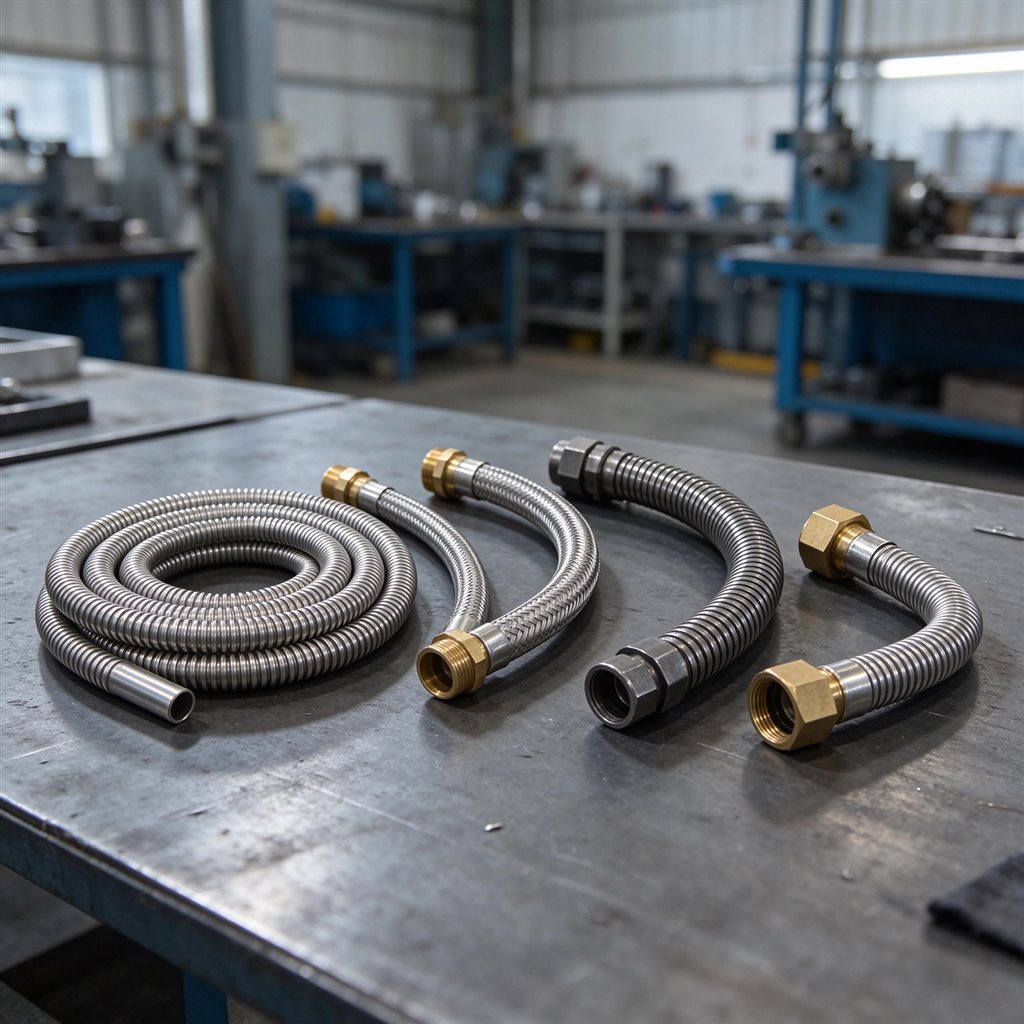
The reason this matters is commercial, not academic. An importer serving both a domestic Chinese gas utility and a North American distributor needs tube built to two different rule sets, and the two are not interchangeable. What separates a factory that can genuinely quote both from one that cannot is not a longer certificate list — it is whether the factory has been audited against each regime and whether its engineers helped write the rules in the first place.
Hangzhou Hengtong Metal Hose Co., Ltd. has manufactured stainless steel corrugated gas hose since 1990. Our engineers were among the drafting units for GB/T 26002-2025 and GB 41317-2024, we hold CSA certification and CABR factory approvals (CGA-SSG-3A-2017, CGA-ZJG-6A-2016), and we were the first Chinese producer to export this product type to the United States, with IAPMOF approval in 1994. This article explains how one line serves four standards, and where it cannot.
The single most useful thing a buyer can understand is that these standards govern different product roles, different pressure classes and different markets, so "equivalent" never means "interchangeable." The four most commonly requested are GB/T 26002-2025 (gas transmission tubing), GB 41317-2024 (mandatory appliance connector standard), GB 44017-2024 (mandatory metal-clad connector standard) and the North American CSST listings under ANSI LC-1 / CSA 6.26.
| Standard | Product role | Market / status | Pressure | Defining constraint |
| GB/T 26002-2025 | Gas transmission corrugated tubing | China, recommended standard | PN ≤ 0.2 MPa, DN10–DN32 | No circumferential welds; 8-year service life marking |
| GB 41317-2024 | Appliance connection hose | China, mandatory, CCC catalogue | Low pressure | QR traceability code inside pack; 8-year life |
| GB 44017-2024 | Metal-clad appliance connector | China, mandatory, CCC catalogue | ≤ 0.01 MPa, DN10/DN15 | Length ≤ 2000 mm; braided + armoured layers |
| ANSI LC-1 / CSA 6.26 | CSST piping system | North America, listing regime | 5 psi / 25 psi listed | Direct burial excluded; qualified installer required |
The GB/T 26002 equivalent ANSI LC-1 CSA 6.26 certification question comes up in almost every export RFQ, and it has a precise answer: the two are not equivalent documents. GB/T 26002 governs how the tube is manufactured in China; the ANSI LC-1 / CSA 6.26 listing governs where a CSST system may be installed in North America and is tied to a named manufacturer, a factory inspection and follow-up audits. A factory can hold both, but proving one does not prove the other. When a supplier claims a "GB/T 26002 equivalent ANSI LC-1 CSA 6.26 certification," ask which certificate number is held by which legal entity and in which certifier's database it can be verified.
The same distinction runs through the domestic mandatory standards. GB 41317-2024 and GB 44017-2024 both sit in the CCC catalogue and took effect on 1 August 2024, but they cover different connector constructions and different pressure classes. GB 41317 hose carries a traceability QR code inside the pack; GB 44017 metal-clad connector is limited to DN10/DN15, 0.01 MPa and a maximum length of 2000 mm. A product compliant with one is not automatically compliant with the other.
In practice this also changes how a mixed order is packed. Tube for the domestic utility, connectors for the CCC catalogue and CSST for the North American distributor go into separate coils, separate cartons and separate packing lists, each carrying the marking its own regime requires. A factory that offers to "put them all on one pallet to save freight" has not understood that the document pack travels with the physical product.
✅ Bottom line: Four standards mean four SKUs. The grade, wall, jacket, fittings, marking and document pack change with the standard — manufacture to the one your destination market actually enforces, not to whichever certificate the factory happens to display.
One factory can hold four standards only if it separates them at four control points: material, forming, assembly and documentation. The tube-forming equipment may be shared, but the inputs and the release tests are not.
At the material point, a North American CSST order typically calls for ASTM A240 Type 304 strip with a UV-resistant yellow jacket; an EN-facing project may call for EN 1.4404 (316L); the domestic mandatory connector standards specify their own inner-hose wall, braid wire and armour thickness. These are purchased as separate heats with separate EN 10204 3.1 mill certificates, and the heat number is carried forward to the coil label. A factory that cannot show heat-to-coil traceability is not running four standards — it is running one product with four cartons.
At the forming and assembly point, GB/T 26002 tube is produced with at most one longitudinal weld and no circumferential weld, then jacketed and marked for an eight-year service life; the appliance connector standards add braid, armour or over-moulded fittings and strict length limits; the CSST system adds striker plates, bonding instructions and a coil marking requiring a qualified installer. The CSST manufacturer CSA certification China export requirements that buyers quote are really a demand that these assembly-level differences be controlled and audited, not merely that a strip of the right grade exists.
At the documentation point, the what certification needed to sell corrugated gas tubing in Canada answer is a document set: the active CSA listing held by the actual manufacturer, the LC-1 system manual, striker-plate and bonding instructions, qualified-installer evidence, EN 10204 3.1 certificates cross-referenced to the batch, and the commercial invoice, packing list and certificate of origin with the correct HS code. The CSST manufacturer CSA certification China export requirements are satisfied only when the certificate, the product marking and the shipment documents all name the same legal entity.
A fifth control point is easy to overlook: the listing has to be kept alive. CSA and IAPMO approvals carry follow-up factory audits, and a certificate that appeared on a website last year may have lapsed after an unannounced visit. Before you pay a deposit, check the listing's current status in the certifier's public database and confirm the audit history is up to date. This is the practical reason buyers search for what certification needed to sell corrugated gas tubing in Canada and still end up with goods held at the border — the certificate existed once, but not on the ship date.
This is where being a drafting unit changes the answer. A factory that helped write GB/T 26002-2025 and GB 41317-2024 does not learn the test basis from a customer's RFQ — it can explain why a clause exists, what the round-robin data showed and which deviation will be caught at certification. For the buyer, that reduces the risk of a supplier quoting a product that passes visual inspection but fails the listed test programme. HENGTONG builds to each regime as a separate SKU and returns the certificate set, the model and the traceability route for the destination you name.
✅ Bottom line: Shared machinery is normal; shared documentation is not. Ask for the certificate, the coil marking and the mill certificate to carry the same manufacturer name and heat number — if they do not, the four-standard claim does not survive a audit.
Q: Can one coil be sold into both the Chinese and North American markets?
A: No. The grade, jacket, fittings, marking and listing differ, so they must be separate SKUs built and documented to separate standards. A CSA listing is tied to the named manufacturer and product construction; relabelling a domestic coil does not transfer the listing. This is exactly what the CSST manufacturer CSA certification China export requirements are designed to prevent — the certificate names the factory, the product construction and the audit trail together, so a coil built to a different standard cannot inherit the approval by sharing a carton.
Q: What does "GB/T 26002 equivalent ANSI LC-1 CSA 6.26 certification" actually prove?
A: It proves nothing on its own — "equivalent" is a sales phrase, not a certification status. What counts is the active listing number, the legal entity holding it, and the certifier's database entry. Ask for those three and verify them independently before you book a container.
Q: Why does a drafting-unit factory reduce my import risk?
A: Because it can trace a clause to its test basis and tell you which deviations will fail certification, rather than discovering that at the port. It is a knowledge advantage that shows up in fewer rejected batches and clearer document packs — and it is the one advantage a trading company cannot copy.
Tell us your destination markets, product roles and sizes, and we will return the exact model, the certificate set held by the named manufacturer, the MOQ and a factory-direct price for each — including the what certification needed to sell corrugated gas tubing in Canada document set, line by line, so you can see what is held and what is still in process. HENGTONG provides OEM and ODM corrugated stainless steel gas hose and connectors to importers, distributors and appliance OEMs worldwide — custom diameters, wall thicknesses, coating colours, pre-assembled fittings, private-label packaging and full documentation support. Hangzhou Hengtong Metal Hose Co., Ltd. operates 6,000 m² with 10+ automated lines and 1,000+ tonnes of annual capacity, and is a drafting unit of GB/T 26002-2025 and GB 41317-2024. Request the free certification matrix and see which standard your product must actually carry.


Let's get in touch.
Privacy statement: Your privacy is very important to Us. Our company promises not to disclose your personal information to any external company with out your explicit permission.
Fill in more information so that we can get in touch with you faster
Privacy statement: Your privacy is very important to Us. Our company promises not to disclose your personal information to any external company with out your explicit permission.