

Please Leave Us A Message
Privacy statement: Your privacy is very important to Us. Our company promises not to disclose your personal information to any external company with out your explicit permission.
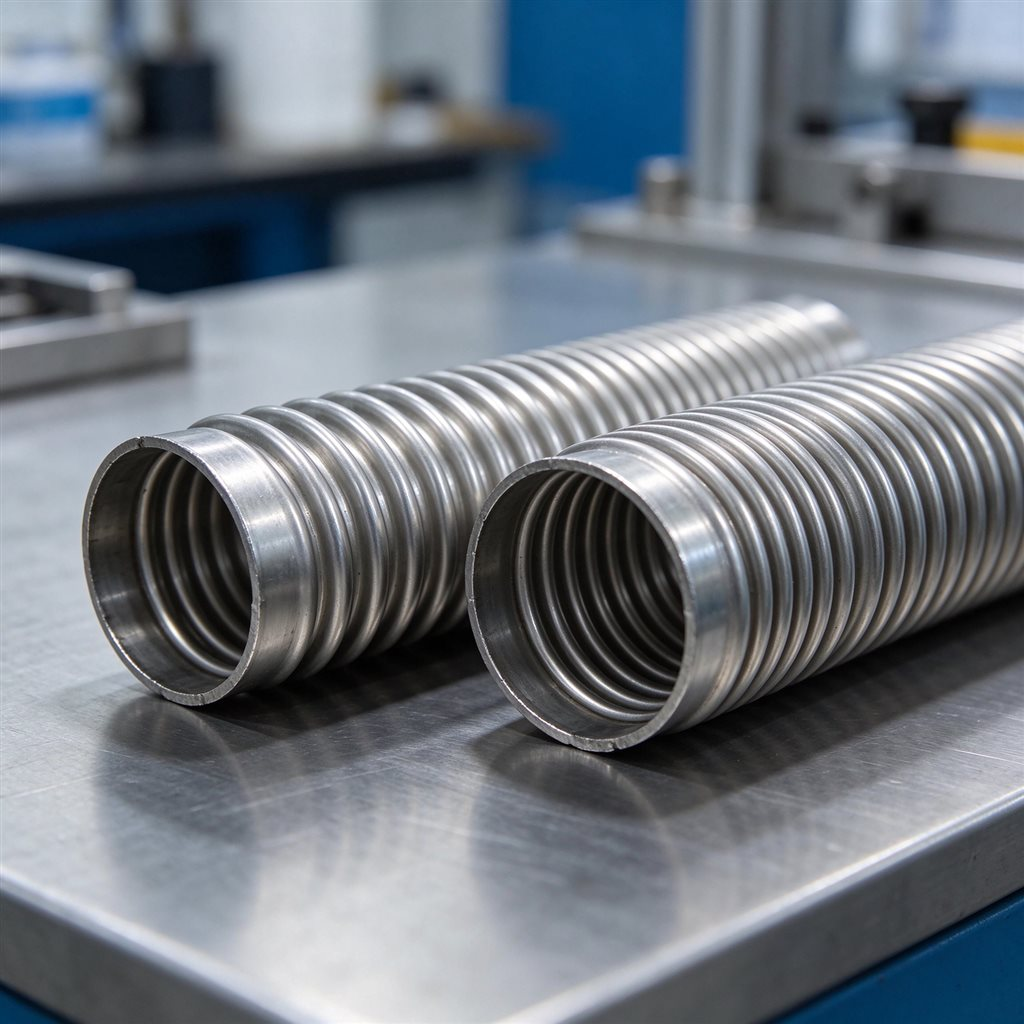
Hangzhou Hengtong Metal Hose Co., Ltd. has formed small-diameter stainless corrugated tube since 1990 and publishes wall, pitch and pressure figures for every size in its RSB range, because the three belong together on a purchase order.
A corrugated gas hose wall thickness 0.2mm 0.25mm which to specify question has no single answer — the right value depends on the nominal size, the grade and the listing the tube is built to. The international figures in common production are below; treat them as a working envelope, not as permission to substitute one for another.
| DN | Strip wall (mm) | Corrugation pitch (mm) | Bare tube OD (mm) | Typical rating |
| 10 | 0.25 ± 0.02 | 3.0 ± 0.20 | 13.7 ± 0.2 | PN ≤ 0.2 MPa / 25 psi listed |
| 15 | 0.25 ± 0.02 | 4.0 ± 0.20 | 18.7 ± 0.2 | PN ≤ 0.2 MPa / 25 psi listed |
| 20 | 0.25 ± 0.02 | 4.5 ± 0.20 | 25.0 ± 0.3 | PN ≤ 0.2 MPa / 25 psi listed |
| 25 | 0.30 ± 0.025 | 5.0 ± 0.3 | 32.0 ± 0.3 | PN ≤ 0.2 MPa / system limit |
| 32 | 0.30 ± 0.025 | 6.0 ± 0.3 | 40.0 ± 0.4 | PN ≤ 0.2 MPa / system limit |
The CSST corrugation pitch and wall thickness selection chart above encodes a design trade-off, not a menu. Thicker strip raises burst margin and handling damage resistance but stiffens the tube; wider pitch increases flexibility per unit length but reduces the number of convolutions sharing an axial load. Move either one without recomputing the other and the tube can pass a dimensional check and still fail the bending or pressure test. This is why the CSST corrugation pitch and wall thickness selection chart belongs on the drawing as a pair of values, never as a single number.
Three physical relationships explain the figures. Hoop stress in the tube wall rises with bore and falls with wall thickness — which is precisely why the matrix steps from 0.25 mm at DN20 to 0.30 mm at DN25 and DN32. Fatigue life is governed by corrugation peak strain, which grows as radius tightens and as pitch narrows. And pressure capacity in a corrugated tube is not the same as in a smooth pipe: the convolutions carry load in membrane, so the listing test, not a wall-thickness formula, is the evidence that counts.
The corrugated gas hose working pressure 0.2 MPa PN rating explained in plain terms is a system ceiling, not a burst pressure. A PN of 0.2 MPa (2 bar, about 29 psi) is the maximum working pressure for gas transmission tube under the Chinese national framework; ANSI LC-1 / CSA 6.26 lists CSST at 5 psi or 25 psi; EN 15266 is built around an MOP of up to 0.5 bar. None of these is the pressure at which the tube fails — burst figures are far higher — they are the ceilings within which the listed system is designed to operate with its required safety factor.
Material grade interacts with the same numbers. A 304 strip at 0.25 mm and a 316L strip at 0.25 mm do not resist chloride attack equally, and if the tube runs hot in a coastal or pool-chemical environment, grade matters more than an extra 0.05 mm of wall. Specify the grade with the wall, not after it. Chloride stress corrosion cracking needs three conditions at once — chloride ions, tensile stress and temperature above roughly 50°C — and a tube selected only on wall thickness can still meet all three in service. The polyethylene jacket is part of the pressure design in this sense: it keeps chlorides away from the strip, so specifying wall and grade without specifying the coating leaves the selection unfinished.
One more distinction matters when you read a corrugated gas hose working pressure 0.2 MPa PN rating explained on a supplier's page. Gas transmission tube and appliance connector are different products with different pressure envelopes — the connector is a short, purpose-made assembly rated in inches of water column, while the transmission coil is the distribution run. A wall and pitch matrix belongs to the transmission product; applying its figures to a connector is a category error that shows up at the fitting, not on the coil.
✅ Bottom line: Specify wall thickness and pitch as a pair for each DN, and verify both against the mill certificate — a correct DN with the wrong strip is a tube built to a different design.
The cheapest way to buy this product is to match the matrix to the actual duty; the most expensive is to pay for a heavier wall that the installation cannot use. Start from the listing your destination market requires, then work back to the wall and pitch that the manufacturer certifies against it.
For a North American CSST system, specify the 25 psi listed product where the design calls for it, and confirm the fitting, striker plate and bonding accessories are listed to the same system — the rating belongs to the assembly, not the coil alone. For an EN 15266 project, the 316L grade and the EN 13501 jacket criteria travel with the pressure class; a 304 tube at the same wall is a different product. Where a buyer asks for something above the standard envelope — a heavier wall at DN25, a custom pitch for a tight routing — that is an engineered request and must be agreed against a drawing and a test programme before production.
HENGTONG builds the RSB series to the wall-and-pitch matrix above, in 304 and 316L, and supplies the mill test certificate and batch pressure-test result with each shipment. Our tapered rigid-seal termination removes the gasket and the circumferential weld, so the pressure path has one fewer weak point than a conventional fitting. For a corrugated gas hose wall thickness 0.2mm 0.25mm which to specify decision on a specific market and DN, we return the certified figures rather than a rule of thumb.
Hangzhou Hengtong Metal Hose Co., Ltd. runs 6,000 m² with 10+ automated lines and 1,000+ tonnes of annual capacity, and holds CSA, IAPMOF and ISO 9001/14001/45001 certification. We provide OEM and ODM supply — custom walls, pitch, lengths, coating colours and private-label packing — to importers and distributors who need the CSST corrugation pitch and wall thickness selection chart printed on their own data sheet.
Two checks close the loop before you release an order. Ask the mill to state the strip thickness as supplied on the certificate for the batch, not the nominal design value — a tolerance that drifts low changes hoop stress at every DN. Then confirm the pressure figure is printed on the tube and the coil label with the standard edition year; a coil that carries a rating without a current listing is a claim, not evidence. The corrugated gas hose working pressure 0.2 MPa PN rating explained on the data sheet is only useful when it is tied to a named standard and a traceable batch.
✅ Bottom line: Match wall and pitch to the listing your market requires, confirm both on the batch certificate, and treat the pressure figure as a system ceiling — never as a substitute for the assembly's test evidence.
Q: Can I use a 0.2 mm wall to save cost on DN15? A: This is exactly the corrugated gas hose wall thickness 0.2mm 0.25mm which to specify decision that should be settled by the listing, not by price. Not against a listing that certifies 0.25 mm. A thinner strip may pass a visual and dimensional check, but it changes hoop stress, burst margin and handling damage resistance, and it invalidates the test basis of the listed product. If a supplier offers it as equivalent, ask which standard and which test report supports the substitution.
Q: Does a thicker wall always mean a longer service life? A: No. Wall thickness buys burst margin and resistance to handling damage, but fatigue life is dominated by bend radius and by the pitch-to-wall geometry at the corrugation peaks. A heavier wall bent too tightly will still crack. Specify the radius and support spacing alongside the wall.
Q: Why does the pressure rating stop at 0.2 MPa when the tube can withstand far more? A: Because the rating is a working ceiling for the gas system, set with a safety factor and tied to the fittings, jacket and installation method. Burst pressure is a separate test result. Buying on burst strength and installing at a higher pressure than the listing allows puts the assembly outside its certification.
Send us your destination market, standard, DN sizes and pressure class, and we will return the certified wall thickness, corrugation pitch and pressure figures, the mill certificate format, MOQ, lead time and a factory-direct price. HENGTONG supplies OEM and ODM corrugated stainless steel gas hose to importers and distributors — matched fittings, custom walls and pitch, private-label packing and full test documentation. Hangzhou Hengtong Metal Hose Co., Ltd. has produced corrugated gas hose since 1990. Ask for the selection matrix and we will confirm the figures against your listing.


Let's get in touch.
Privacy statement: Your privacy is very important to Us. Our company promises not to disclose your personal information to any external company with out your explicit permission.
Fill in more information so that we can get in touch with you faster
Privacy statement: Your privacy is very important to Us. Our company promises not to disclose your personal information to any external company with out your explicit permission.