

Please Leave Us A Message
Privacy statement: Your privacy is very important to Us. Our company promises not to disclose your personal information to any external company with out your explicit permission.
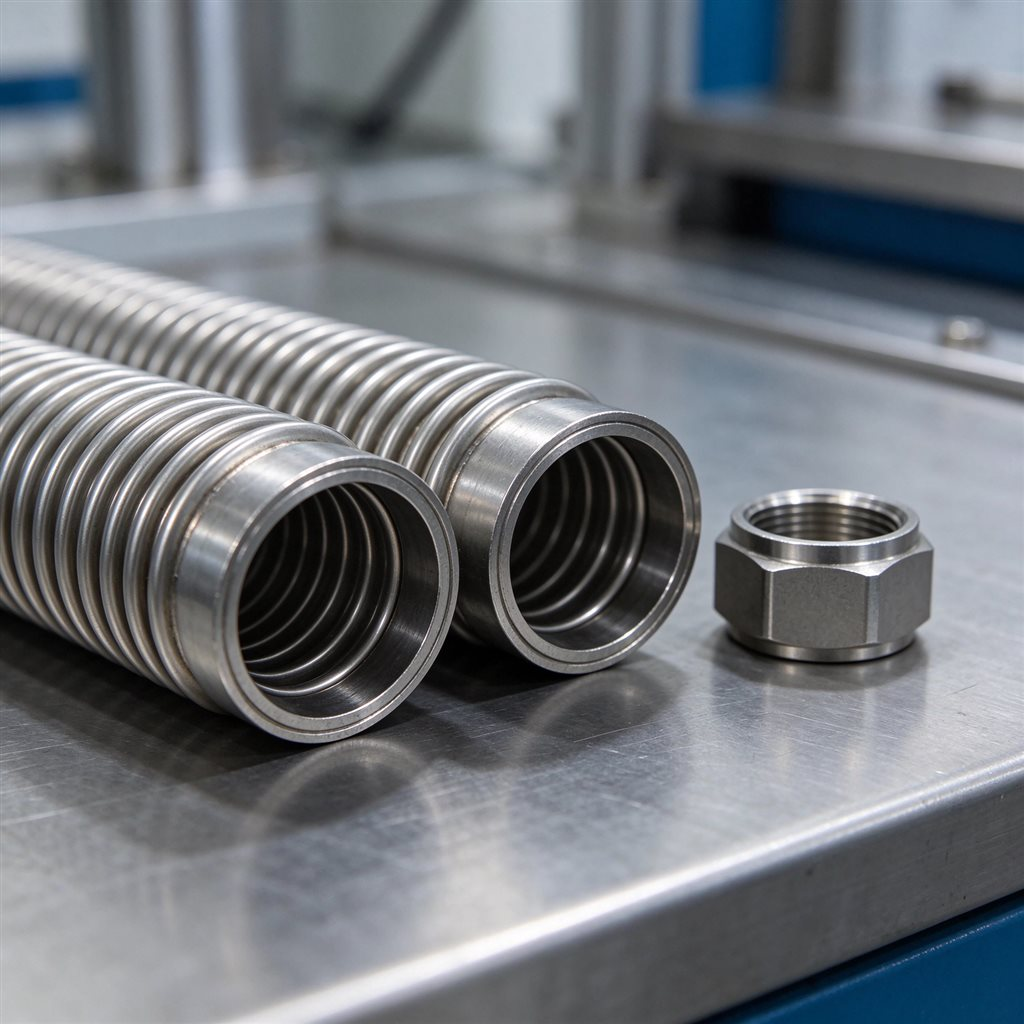
Hangzhou Hengtong Metal Hose Co., Ltd. has supplied corrugated stainless tubing to importers since 1990 and treats the size designation as a contract term, printing bore, outside diameter and thread family together on every data sheet.
The gas tubing nominal diameter vs outside diameter difference is the single most common cause of a rejected gas hose shipment, and it survives inspection because nothing on the coil is technically wrong. A buyer who writes "DN20, 20 mm" has specified a bore class and then attached a diameter to it that belongs to neither the bore nor the standard outside diameter. The factory builds to the designation; the fittings are cut to the assumed diameter; the two meet at goods-in and do not fit.
The underlying rule is simple. DN is a nominal bore identifier — a label for the flow class — not a dimension you can put a calliper against. The corrugated stainless steel tubing DN10 DN15 DN20 DN25 DN32 dimensions that matter for fit are the bare-tube outside diameter and the thread family, and these differ by the standard the mill built to. A DN20 tube has a bore near 19.6–19.8 mm but an outside diameter of 21.7 mm under ISO 10380 and 25.0 mm under EN 15266 and the Chinese gas-transmission standard. Same label, two different mating envelopes.
| DN | Bare tube OD, ISO 10380 | Bare tube OD, EN 15266 / GB transmission | Consequence if confused |
| 10 | 13.5 mm | 13.7 mm | Metric fitting seats differently |
| 15 | 17.2 mm | 18.7 mm | Compression nut will not seal |
| 20 | 21.7 mm | 25.0 mm | Fitting cannot be threaded on |
| 25 | 27.5 mm | 32.0 mm | O-ring lands outside the seat |
| 32 | 35.0 mm | 40.0 mm | Assembly rejected at goods-in |
The minimum bore 98 percent DN ISO 10380 gas tubing requirement is the check that separates a genuine mechanically formed tube from a substitution. ISO 10380:2012 sets the internal diameter at no less than 98% of the nominal designation — DN20 must have a bore of at least 19.6 mm. This is a useful anti-fraud test precisely because it is independent of the outside diameter: a welded tube with a heavy wall can carry the right OD label and still fail on bore. A buyer who checks only the outside diameter passes the fake and rejects the genuine article.
Three habits cause most of the damage. First, translating DN into inches and ordering against the converted figure, which compounds a designation error with a rounding error. Second, assuming that a competitor's DN20 is interchangeable with yours because the labels match. Third, omitting the thread family — metric R (Rp/Rc) to ISO 7-1, North American NPT, or UK G/BSPP — so that a tube with the correct outside diameter still arrives with a thread that cannot be assembled. Getting the diameter right is only half the problem; the thread is the other half, and neither one is implied by the DN label.
The reason this is so easy to get wrong is that the finished hose looks nothing like its nominal size. The corrugation is formed mechanically from strip, then a polyethylene jacket is added on top, so the outside diameter a buyer measures with a calliper is larger than the bare tube that mates with the fitting. Add the jacket thickness — and the fact that some suppliers quote the bare-tube diameter while others quote the coated diameter — and two datasheets for the same DN can disagree by several millimetres without either being fraudulent. Ask which diameter is being quoted, every time.
✅ Bottom line: DN is a bore class, not a diameter. State the outside diameter and thread family on the order, or the coil you ordered correctly will still be the wrong coil.
A rejection-proof order names all four identifiers — nominal size, outside diameter, thread family and listing standard — so that no two factories can read it differently. The gas tubing nominal diameter vs outside diameter difference stops being a problem the moment both numbers appear in the same line of the purchase order.
Write the designation in full: "DN20, bare tube OD 25.0 mm, R3/4 female to ISO 7-1, to EN 15266", or the NPT equivalent for a North American CSST system. If you are matching an existing installation, measure the fitting and state the outside diameter you actually need rather than the number on the old drawing. The corrugated stainless steel tubing DN10 DN15 DN20 DN25 DN32 dimensions on a factory data sheet are the reference to specify directly — but only after you have confirmed they belong to the standard your market accepts.
At goods-in, check three things in order. Measure the bare-tube outside diameter on a cut sample, away from the jacket. Verify the bore against the 98% rule — the minimum bore 98 percent DN ISO 10380 gas tubing requirement gives you a pass/fail threshold that needs no interpretation. Then confirm the thread with a mating gauge rather than by eye. A tube that clears all three will fit; one that fails any of them is a documentation problem that has already become a physical one.
The commercial cost is worth stating plainly. A rejected container means return freight, a replacement lead time, and a project season lost — far more than the per-metre saving that usually motivates a substitute wall or an assumed size. This is why the corrugated stainless steel tubing DN10 DN15 DN20 DN25 DN32 dimensions should be agreed before the container is booked, not discovered at the port. Ask the supplier to stamp the designation on the coil label and to include the measured values in the batch documents, so the person receiving the goods can verify without a phone call. For a distributor stocking several DN sizes, the same discipline prevents a worse problem: a mixed pallet in which nominally identical coils will not share a fitting, and every order picked from it carries a small risk of rejection downstream.
HENGTONG prints nominal size, bore, outside diameter and thread family on every data sheet and coil label, and supplies the mill certificate and batch bore measurement with each shipment. We provide OEM and ODM corrugated stainless steel gas tubing to importers and distributors — custom diameters, wall thicknesses, thread families and private-label packing — built to the standard your destination market requires. Our tapered rigid-seal termination removes the gasket and circumferential weld, so the fitting you specify seats on a consistent envelope.
Hangzhou Hengtong Metal Hose Co., Ltd. runs 6,000 m² with 10+ automated lines and 1,000+ tonnes of annual capacity, and holds CSA, IAPMOF and ISO 9001/14001/45001 certification. Send the drawing and we will return the dimensional confirmation before production.
✅ Bottom line: Put the outside diameter, bore check and thread family on the purchase order in the same line as the DN. A number that cannot be misread is the only reliable defence against a rejected shipment.
Q: If two suppliers both quote DN20, why do their fittings differ? A: Because they built to different standards with different outside-diameter envelopes — ISO 10380 gives 21.7 mm, EN 15266 and the Chinese gas-transmission standard give 25.0 mm. The bore requirement is common to both; the outside diameter is not. State the outside diameter you need instead of assuming the label fixes it.
Q: How do I check the bore without a full test lab? A: On a cut sample, measure the internal diameter and compare it with 98% of the nominal designation. That threshold is the minimum bore 98 percent DN ISO 10380 gas tubing requirement in its simplest form, and it is enough to catch a heavy-wall substitute whose outside diameter looks correct.
Q: Can I convert DN to inches and order that way? A: No. DN is a designation, and an inch conversion is an approximation that loses both the bore class and the thread family. Order the designation, the measured outside diameter and the thread standard together. That is the whole point of specifying the gas tubing nominal diameter vs outside diameter difference at the ordering stage.
Send us your DN size, target outside diameter, thread family and destination standard, and we will return the dimensional confirmation, the bore measurement method, MOQ, lead time and a factory-direct price. HENGTONG supplies OEM and ODM corrugated stainless steel gas hose to importers and distributors — matched fittings, private-label packing and full batch documentation. Hangzhou Hengtong Metal Hose Co., Ltd. has produced corrugated gas hose since 1990. Ask for the confirmation and we will resolve the designation before production


Let's get in touch.
Privacy statement: Your privacy is very important to Us. Our company promises not to disclose your personal information to any external company with out your explicit permission.
Fill in more information so that we can get in touch with you faster
Privacy statement: Your privacy is very important to Us. Our company promises not to disclose your personal information to any external company with out your explicit permission.